
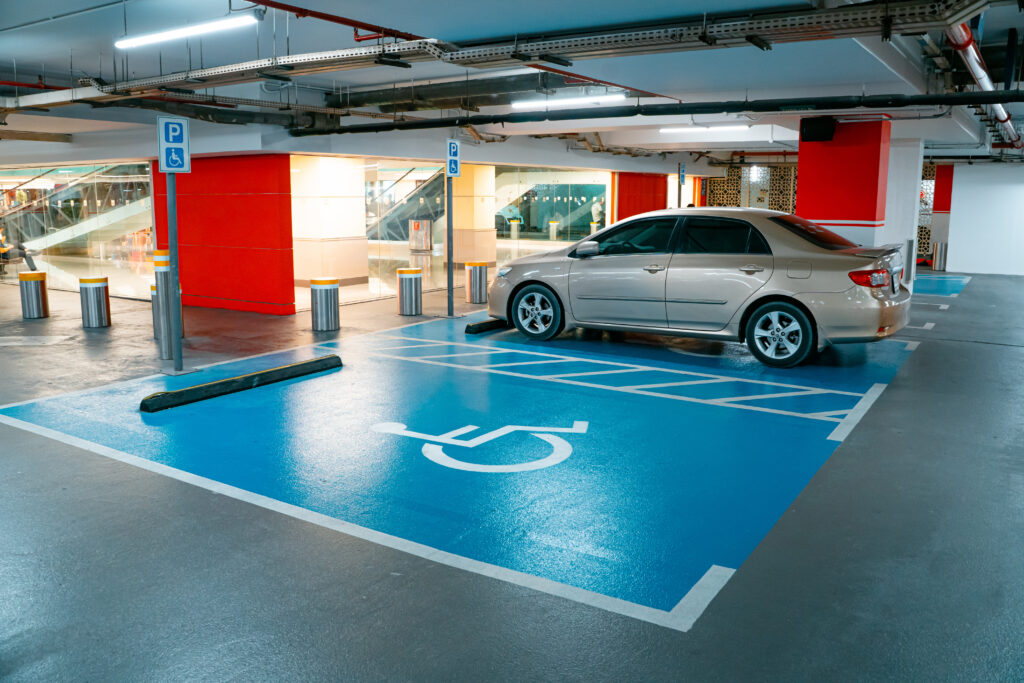


ADA compliance in hospital parking isn’t a paperwork exercise. It’s the first physical interaction most patients have with your facility, and it carries real legal, financial, and reputational weight. Every accessible space, access aisle, and signage element must meet federal standards, or your hospital risks Department of Justice complaints, private lawsuits, and avoidable harm to the patients you’re there to serve. The number of ADA-compliant parking spaces your hospital needs depends on the total size of your lot, but the requirements go well beyond a count. This checklist walks through what operations managers need to verify, how often, and where facilities most often fall short.
The ADA Standards for Accessible Design set the baseline for accessible parking at every hospital parking facility. The required count scales with your total lot size: lots with 1 to 25 spaces need at least one accessible space, lots with 100 spaces need four, and larger facilities continue to scale from there. Hospital outpatient facilities carry a stricter standard, requiring that at least 10 percent of patient and visitor parking be accessible.
Of every six accessible spaces, at least one must be van-accessible. Dimensional requirements are specific:
An accessible route must connect each space to the hospital entrance without stairs, and any elevation changes along that route require a compliant curb ramp. Signage is equally prescriptive. Each space needs a sign displaying the International Symbol of Accessibility, mounted at a height that remains visible when a vehicle is parked in the space. Van-accessible spaces require additional “Van Accessible” signage.
Most ADA violations in hospital parking don’t come from the original lot design. They come from wear, weather, and inconsistent maintenance over time. That’s good news for operations managers: these gaps are predictable, and a proactive inspection routine catches them before they become liabilities.
The most common hospital parking ADA compliance mistakes include:
A quarterly visual walk-through catches most of these issues while they’re still cheap to fix. An annual documented compliance audit, ideally conducted by a third party, creates a paper trail that protects the hospital if a complaint is ever filed. For hospitals without an in-house team trained to spot these gaps, working with a parking partner that understands healthcare operations closes the loop between compliance and daily operations. FC Parking’s hospital parking services include the kind of routine oversight that keeps accessible spaces compliant year-round.
More than 61 million U.S. adults live with a disability, and for many of them, parking is the first test of whether your hospital is truly accessible. A compliant, well-maintained parking facility signals dignity and respect before the patient ever reaches the front door. A non-compliant one invites complaints, erodes trust, and creates legal exposure your facility doesn’t need.
Connect with our parking experts at FC Parking to ensure your hospital parking facility meets ADA standards while maintaining operational efficiency and patient safety.